China is the most decentralized country in the world by expenditure shares (Wingdenger, 2018), meaning that the subnational governments which include provinces, prefectures, counties and townships, have significant responsibilities for public spending.
While subnational governments have the autonomy to allocate resources, make decisions about infrastructure development, and incur expenditures, they lack the authority to generate revenue through taxation to fund such expenditure.
Tax Revenue and Expenditure disparity
Local governments collect around 60% of overall taxes, but tax rates are set by the central government, and their reliance on revenue-sharing limits their authority. If one observes the contribution of decentralized fiscal policy in the growth of China with rapid infrastructure development and booming economy, it would be considered an asset to China’s economic growth. However, the subnational governments are dependent mainly on central government’s fiscal transfers, various subsidies or land finance as their primary revenue source. Land finance refers to creating revenue through land by either collecting land and property taxes or selling land usage rights (Wong C. e., 2013)
Over the previous two decades, steeply rising land prices resulted in an expanding property industry, which assisted local governments in maintaining their public spending. The share of total local government revenue from land sales climbed from 20% in 2012 (2.7 trillion yuan) to 30% in 2021 (8.7 trillion yuan) (YU, 2023).
LGFVs and China’s Debt problem
Another key source of financing for local governments that can be covered in the ambit of land finance are LGFVs (Local government financing vehicles). In China, land finance through LGFVs meant borrowing money from banks or capital markets via special-purpose corporations backed by local governments. These LGFVs are not formally included in the local government budget but are sometimes implicitly or explicitly guaranteed by the local government, which owns the land and assets used as collateral for revenue sources (Kozhevnikov, 2019).
LGFVs have helped China’s urbanization and economic expansion and are considered the backbone of local governments in China when it comes to promoting infrastructure development. They are largely involved in the development of public welfare projects such as cheap housing, infrastructure, social services, and ecological and environmental protection (Sun, 2013), but they also offer fiscal and financial risks due to their high leverage, low profitability, and lack of transparency.
Since land is a finite source, this method of revenue generation is not sustainable. The extra-budget borrowing to finance the expenditure added to the local government debt which stood at trillion yuan (US$7 trillion) at the end of 2020, according to estimates (Lee, 2021). This constituted a tremendous burden on local budgets, necessitating continued borrowing for most of the municipalities that lack the capacity to pay (Wong C. , 2021).
In the absence of regulatory monitoring, these practices fueled bribery and corruption, leaving many cities in unsustainable debt. In 2014, the government in 2014 had to revise the budget law, allowing issuance of bonds by provincial governments. Despite attempts at converting the LGFV debt to local government debt and bringing bond-issuance under the purview of Central government, LGFVs continue “backdoor” borrowing. (Wingdenger, 2018) Considering the abovementioned facts and data, it can be said that China’s decentralized fiscal policy is flawed. It grants excessive responsibility to local governments but in the absence of revenue-generation mechanisms, these governments opt for unsustainable means, thus becoming an obstacle to economic growth by pushing the economy towards a debt crisis.
Unequal Growth
Furthermore, the implicit tax rate and fiscal responsibilities to sustain the running of local government vary greatly between jurisdictions due to large disparities in basic economic structures and revenue bases (Zhang, 2006). Urban local governments have more capacity for spending than their rural counterparts. In certain regions that are more dependent on agriculture or are primarily rural, fewer funds are available for local governments. The degree of industrialization and urbanization influences the economic structure and income base of different regions. The per capita GDP of coastal regions and big urban agglomerations in 2020 was much higher than that of peripheral and less urbanized counterparts, according to Statista[1]. Shanghai, for example, had a per capita GDP of 164,000 yuan, whilst Guizhou had only 38,000 yuan. From 1999 to 2009, differences in actual fiscal revenue among prefecture-level administrative regions widened, resulting in a persistent rise in the Theil index[2]. (Tan, 2019)
This impacts their level of spending on fundamental necessities of the population, such as education and health. Though increased central transfers as well as different policies targeting rural population or migrant children slow the trend of expanding regional disparities, the same remains significant. Disparities between counties and districts within a province are also substantial, affecting vulnerable groups and marginalized communities. (Wong C. , 2019)
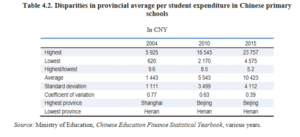
The regional disparities call for a centralized fiscal policy in China, as the decentralized policy is unable to deal with the inequalities or provide equitable social service provisions to all sections of society. Subnational governments do play a key role in matters of social welfare, as currently, in China’s decentralized system, important public services such as healthcare, education and social welfare are provided by local governments. (Wong, 2021). However, a centralized system is generally associated with better allocation of resources for reducing disparities and inequalities among regions.
But China’s circumstances are unique, in the sense that it does not have a strong inter-governmental transfer system. Therefore, a centralized fiscal policy might not ensure equitable distribution, resources or reduction of disparities. Currently, these services are highly decentralized and also constitute the fastest-growing public expenditure, considering China’s ageing population and rapid urbanization (Wingdenger, 2018). In 2019, the share of expenditure among central government and local governments showed that county-level expenditure was nearly half of the total budget expenditure, while central government spent merely 15%.
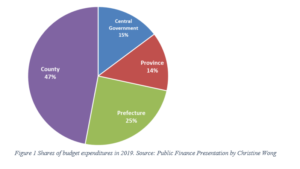
Figure 1 Shares of budget expenditures in 2019.
Despite the revamping of public finance since 1994 to develop a system capable of financing government operations and supporting economic growth, lack of equitable funding for local governments remained the Achilles heel of China’s public finance. Local finances have deteriorated since 2015 as a result of sluggish growth, tax cuts, and budgetary challenges. (Wong, 2021). China also lacks a robust intergovernmental fiscal system that is crucial for securing appropriate funding for local governments.
Tax Reforms
As part of the Tax-Sharing mechanism Reform, China implemented an inter-governmental transfer mechanism in 1995. All taxes were divided into three categories under the reform: central taxes, municipal taxes, and shared taxes. The central government collected central taxes such as excise tax and customs tariff. Local governments collected local taxes such as land VAT and urban land use tax. Shared taxes, including as VAT and income taxes, were split between the central and local governments, with the central government receiving the lion’s share. The reform was a revenue centralization procedure that generated a significant disparity between expenditure responsibility and available local resources (Liu, 2019).
To fill this gap, the central government devised a system of intergovernmental payments comprised of three major components: tax rebates, equalization transfers, and ad hoc transfers. The tax rebate was a mechanism that guaranteed each province an amount equivalent to the local tax base reduction caused by the tax-sharing scheme. It was a “compromised” result of the reform, which sought to protect the interests of the provinces. It has, however, been less and less significant in the system over time. The equalization transfers were formula-based grants with an objective of equalization. General-purpose grants, “pre-tax sharing system” awards, minority grants, and other types were designed to eliminate regional fiscal imbalances and improve public service delivery (Liu, 2019).
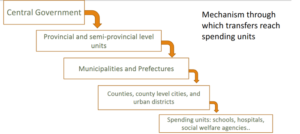
Administrative overhead increased as reliance on transfers increased since inter-governmental transfers in China are made level-by-level from Central government to provincial and then to semi-provincial level units. This trickle-down transfer raises various challenges for transparency, proper utilization of funds and administrative efficiency.
Though the context and circumstances in which inter-governmental transfers were introduced is understandable, yet it also causes several issues. For example, level-by-level transfer mechanism does not address horizontal fiscal imbalances among subnational governments adequately. Transfers also tend to favor the provincial level over the lesser levels of government, particularly the county level, where the majority of public service delivery occurs. (Bihong Huang, 2012)
The Xi Jinping period
Under the Xi Jinping administration, certain governance reforms were proposed. This had three major tasks: strengthening the financial management system, upgrading the tax system, and constructing an intergovernmental structure with adequate resources and duties. (Wong C. , 2021) However, local governments’ fiscal status has deteriorated since the start of the Xi Jinping era.
In each decade, from the Zhu Rongji period (1992-2002) to the current Xi Jinping period, policies were made responding to the problems left by the previous decade. But what China needs is a complete overhaul of the tax-sharing system including tax reform, intergovernmental reform, and a new economic plan that is less reliant on investment.
The impact of fiscal decentralization on economic growth and social service is dependent on design of fiscal decentralization, the institutional quality and capacity of local governments as well as the accountability and transparency of fiscal management (Kim, 2021). In case of China, decentralized distribution of responsibilities is not matched with revenue sharing, leaving a big gap for local government. Due to a lack of funds, local governments in disadvantaged areas, particularly rural areas, are frequently unable to perform mandated services (Wong, 2021).
On one hand China’s decentralized fiscal system has contributed immensely to the progress made by the country in terms of infrastructure development, availability of basic services to the population all leading to the “growth miracle”. The same was needed in the period when China was still catching-up with the leading economies of the world. However, during the contemporary period, the same decentralized fiscal system has led to a position nearing a debt crisis because of the way local governments used LGFVs and shadow banking to finance the projects.
It can be argued that China’s decentralized fiscal system has both advantages and disadvantages for economic growth and provision of social services. It has enabled subnational governments to respond to local conditions and needs in a flexible manner, contributing to China’s rapid and diverse development. But it has also produced significant fiscal issues that may jeopardize China’s long-term growth prospects. The way forward for China includes restructuring its fiscal system for budgetary sustainability and efficiency.
Need of the hour
A reformed, decentralized fiscal policy would be an asset to the economic growth and social service provision of China. These reforms would include allowing subnational governments more autonomy to raise their own revenue in order to reduce their dependence on transfers and borrowing. This should be supplemented with accountability measures, including clear expenditure responsibilities, to avoid duplication of effort, wastage of resources, or conflict with other levels of government. Efforts must be made to find new sources of revenue, reduce local governments’ dependence on land finance, as reduce local government debt.
Finally, China needs a more transparent, smooth, and equitable system of intergovernmental transfers to keep corruption and administrative inefficiency in check. This could be achieved by increasing the share of general-purpose transfers, offering more discretion to subnational governments in spending as compared to specific purpose transfers. But the same must be complemented with a rule-based allocation mechanism as an accountability measure.
Bibliography
Bihong Huang, K. C. (2012). Are intergovernmental transfers in China equalizing? China Economic Review Volume 23, Issue 3, 534-551.
Kim, J. W. (2021). Fiscal policy and economic growth: some evidence from China. . Rev Worl Econ, 157, 555–582.
Kozhevnikov, M. (2019). Debt of Local Governments of China: Assessment Issues and Analysis. Studies on Russian Economic Development, 714–716 .
Lee, A. (2021, November 2). Is China’s local government debt a concern and what role do LGFVs play in infrastructure spending? Retrieved from SCMP: https://www.scmp.com/economy/china-economy/article/3154549/chinas-local-government-debt-concern-and-what-role-do-lgfvs
Liu, Y. (2019). Intergovernmental Fiscal Transfers in China. Retrieved from ESCAP: https://www.bing.com/ck/a?!&&p=98df39b9ca9bca2fJmltdHM9MTY5ODUzNzYwMCZpZ3VpZD0yOTMzZGZkNS1lZWQ2LTZmZDgtMjBhMS1jY2ExZWZkMDZlOWQmaW5zaWQ9NTE4Mg&ptn=3&hsh=3&fclid=2933dfd5-eed6-6fd8-20a1-cca1efd06e9d&psq=Intergovernmental+Fiscal+Transfers+in+China+Yongzheng+
Sun, Y. L. (2013). Local Government Financing Platforms in China: A fortune or misfortune? IMF.
Tan, Z. (2019). A Research on the Fiscal Regional Difference of China’s Prefecture-Level Administrative Regions. Modern Economy.
Wingdenger, P. (2018, April 13). IMF. Retrieved from imf.org: https://www.imf.org/en/Publications/WP/Issues/2018/04/13/Intergovernmental-Fiscal-Reform-in-China-45743#:~:text=China%20is%20the%20most%20decentralized%20country%20in%20the,and%20a%20build-up%20of%20debt%20outside%20the%20budget.
Wong, C. (2019). Public policy for a modernising China: The challenge of providing universal access to education under fiscal decentralisation. Paris: OECD Publishing.
Wong, C. (2021). Plus ça Change: Three Decades of Fiscal Policy and Central Local Relations in China. China: An International Journal, Volume 19, Number 4, , 1-31.
Wong, C. e. (2013). Paying for Urbanization: Challenges for China’s Municipal Finance in the 21st Century. Cambridge, MA: Lincoln Institute for Land Policy.
YU, S. (2023, March 9). China’s local governments boost revenue by selling land to their own entities. Retrieved from Financial Times: https://www.ft.com/content/f68a301a-cdd5-4d9b-aca2-492c6561ebbf
Zhang, X. (2006). Fiscal decentralization and political centralization in China: Implications for growth and inequality. Journal of Comparative Economics Volume 34, Issue 4, 713-726.
[1] https://www.statista.com/topics/7157/regional-disparities-in-china/#topicOverview
[2] A high positive Theil index indicates more income than population while a negative value shows more population than income.